

正信佛友会
Zheng Xin Buddhist Association


【佛法开示:『开心法师』主讲】
讲师 Speaker:
【开心法师】
翻译员 Translator:
【None 没有】
Mar 18, 2026
9:00 AM
-
11:00 AM
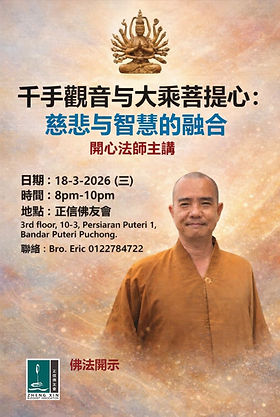
18-3-2026:
【佛法开示:『开心法师』主讲】
《千手观音与大乘菩提心:慈悲与智慧的融合》
【Dhamma Talk by Venerable Kai Xin】
《Thousand-Armed Avalokiteśvara and the Mahāyāna Bodhicitta: The Integration of Compassion and Wisdom》
🌸☘️🌸☘️🌸☘️🌸☘️🌸☘️🌸☘️🌸☘️
💧法師的開示主要围绕:
• 大悲忏的来源
• 千手观音的意义
• 拜忏的真正用意(不是形式)
• 如何把“慈悲 + 智慧”落实在修行中
1️⃣ 为什么讲“大悲忏”?
• 大悲忏源自《千手千眼观世音菩萨广大圆满无碍大悲心陀罗尼经》
• 是中国祖师根据经典整理出来的修行仪轨
• 不只是诵念,而是一套完整修行方法
👉 重点:
忏法 = 经文精神的“实践版”
2️⃣ 很多人拜忏的问题
法師点出一个关键现实:
👉 大多数人:
• 不懂内容
• 不明白意义
• 只是跟着拜
但奇怪的是: 👉 还是很多人愿意一直参加
3️⃣ 为什么“看不懂”还有效?
讲者提出关键原因:
✔️ 因为“感应与感动”
• 法会的音乐(梵呗)会触动内心
• 即使不懂内容,也会产生感动
👉 但问题是: 只有“感动”,不等于真正修行
4️⃣ 真正的关键:理解 +观想
法師强调:
👉 如果不了解内容:
• 只是形式上的拜
• 功效有限
👉 如果理解内容:
• 才能产生“观想”
• 修行才真正深入
例子:
• “香供养十方法界” 👉 不是插香而已
👉 是要观想:供养遍满法界,但真的要達成則須俱足定力。
5️⃣ 忏悔的真正意义
一个重要提问:
👉 你拜忏时,真的在忏悔吗?
很多人:
• 只是跟着念
• 没有真实反省
👉 正确方式:
• 针对自己具体问题忏悔
• 有“觉察 + 改变”
• 有効与否則須依現實的情況確定,如修定快速,讀經理解力增強,或見端相的夢境
6️⃣ 修行的关键原则:
🔹(1)先感动自己
“你不能感动自己,就无法感动别人”
👉 修行不是表演,而是内在真实转化
🔹(2)从形式走向内涵
• 不只是拜
• 要理解、体会、观想
🔹(3)慈悲 + 智慧要结合
• 慈悲:发心利益众生
• 智慧:理解空性与真实
👉 只慈悲 → 容易执着
👉 只智慧 → 容易冷漠
🔹(4)忏法是一种“心的训练”
不是宗教仪式,而是: 👉 训练心的方法
🌸☘️🌸☘️🌸☘️🌸☘️🌸☘️🌸☘️🌸☘️
💧 Main contents of the Dhamma Talk:
▪️The origin of the Great Compassion Repentance (大悲忏)
▪️The meaning of Thousand-Armed Avalokiteśvara
▪️The true purpose of repentance practice (not mere formality)
▪️How to apply “Compassion + Wisdom” in actual cultivation
1️⃣ Why speak about the “Great Compassion Repentance”?
▪️It originates from the Great Compassion Dhāraṇī Sūtra
▪️It was systematized into a practice liturgy by Chinese patriarchs
▪️It is not merely chanting, but a complete method of cultivation
👉 Key point:
▪️Repentance practice = the “Applied Version” of the spirit of the sūtras
2️⃣ Common issues in repentance practice
▪️The Venerable pointed out an important reality:
👉 Most people:
▪️Do not understand the content.
▪️Do not grasp the meaning.
▪️Simply follow along mechanically.
▪️Yet interestingly:
👉 Many are still willing to keep participating.
3️⃣ Why does it seem effective even without understanding?
▪️The speaker explained a key reason:
✔️ Because of “resonance and emotional response”
▪️The ritual music (Buddhist chanting) touches the heart.
▪️Even without understanding, one may feel deeply moved.
👉 But the issue is:
▪️Being emotionally moved ≠ genuine cultivation.
4️⃣ The real key: Understanding + Visualization.
▪️The Venerable emphasized:
👉 Without understanding:
▪️It remains a formal, external practice
▪️Its effectiveness is limited
👉 With understanding:
▪️One can generate visualization (观想)
▪️Practice becomes truly deep
▪️Example:
“Offering incense to all realms of the ten directions”
👉 Not merely placing incense
👉 One should visualize:
▪️Offerings pervading the entire Dharma realm—but to truly accomplish this requires meditative concentration.
5️⃣ The true meaning of repentance:
▪️An important question:
👉 When you perform repentance, are you truly repenting?
▪️Many people:
Just recite along
Without genuine self-reflection
👉 Correct approach:
▪️Repent specific personal faults.
▪️Include awareness + transformation.
▪️Effectiveness is reflected in real outcomes, such as:
▪️Faster progress in meditation.
▪️Better understanding of scriptures.
▪️Meaningful or symbolic dreams.
6️⃣ Key principles of practice
🔹 (1) First, move yourself
“If you cannot move yourself, you cannot move others”.
👉 Practice is not performance, but inner transformation.
🔹 (2) Move from form to essence
Not just bowing.
▪️But understanding, experiencing, and visualizing.
🔹 (3) Combine Compassion + Wisdom
▪️Compassion: the intention to benefit all beings
▪️Wisdom: understanding emptiness and reality
👉 Compassion alone → attachment
👉 Wisdom alone → indifference
🔹 (4) Repentance practice is training of the mind.
▪️Not merely a religious ritual, but:
👉 A method for training and transforming the mind.


